Quantum kernels for drug-molecule binding
Starting Small: Can Quantum Computing Help Predict Drug-Molecule Binding for Alzheimer's Research?
I just kicked off a new side project, and I want to document it from the very beginning - partly for accountability, partly because I think the "messy start" is more useful to share than the polished result.
The question I'm chasing
Alzheimer's drug discovery is brutal. One of the hardest parts is predicting how well a candidate drug molecule will bind to its target protein - get that wrong, and you waste years and enormous amounts of money chasing compounds that never had a shot. Classical computational methods (molecular docking, traditional ML) have made real progress here, but they still struggle with the sheer complexity of protein-ligand interactions and often require heavy manual feature engineering.
That got me wondering: could quantum computing offer a meaningfully different lens on this problem? Not as a magic bullet, but as a genuinely different way of representing molecular complexity - one that might capture the kind of nonlinear structure classical feature engineering tends to flatten out.
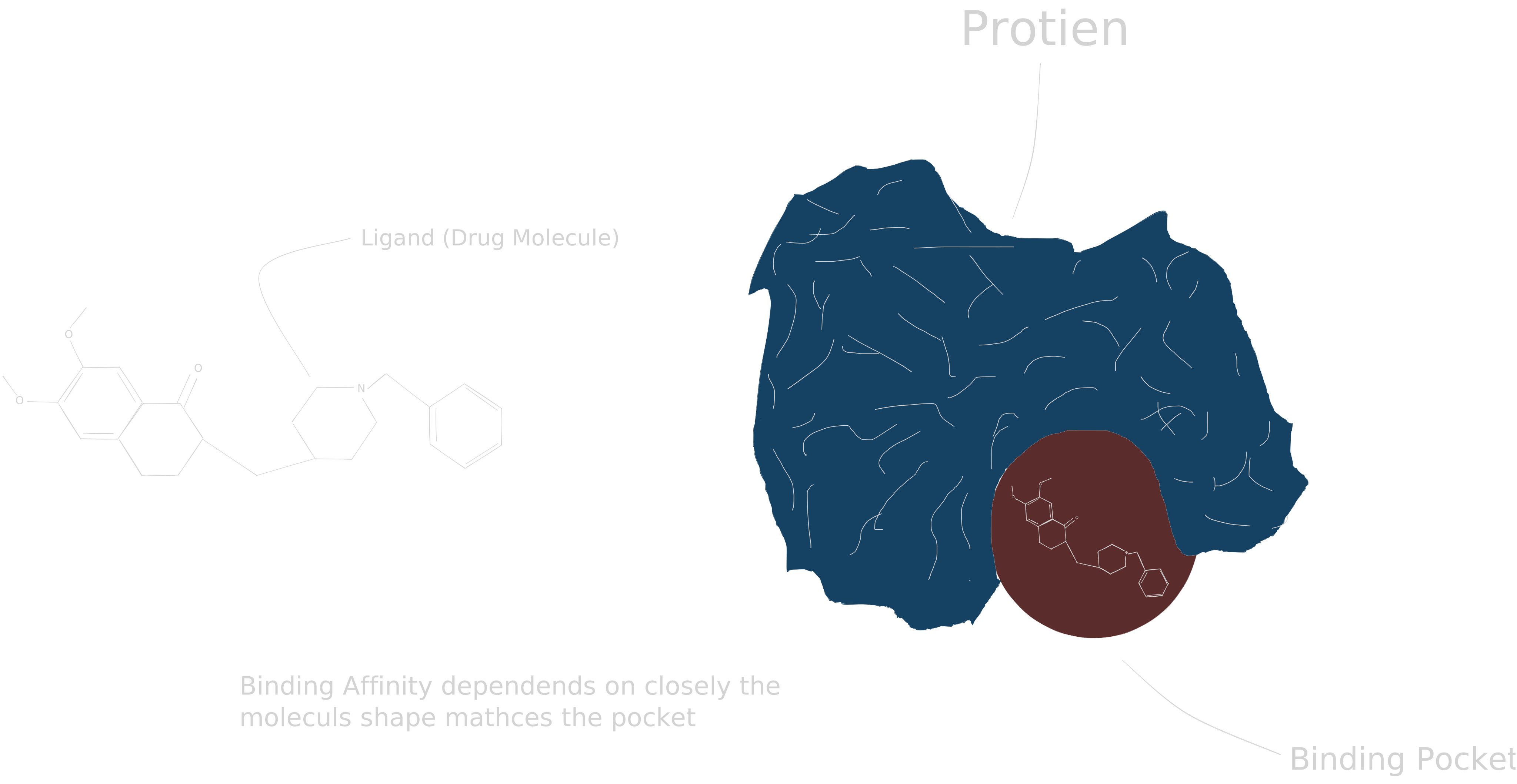 Binding affinity comes down to how well a drug molecule's shape fits a protein's binding pocket - get the fit wrong and the drug won't work.
The foundation I'm building on
Rather than starting from a blank page, I'm building on top of QKDTI (Quantum Kernel Drug-Target Interaction), a framework published in Scientific Reports in 2025. The core idea: transform biochemical features into a quantum Hilbert space using a parameterized circuit, compute a "quantum kernel" from the overlap between the resulting quantum states, then feed that into a support vector regression model to predict binding affinity. The researchers tested it on well-established datasets (DAVIS, KIBA, and BindingDB) and reported that the quantum kernel handled the non-linear relationships in binding data more effectively than the classical baselines they compared against.
What I don't yet have a good feel for is why. Is the entanglement between qubits doing real work, or is some of that gain just an artifact of the benchmark datasets? That's part of what pulled me toward this project instead of just reading the paper and moving on.
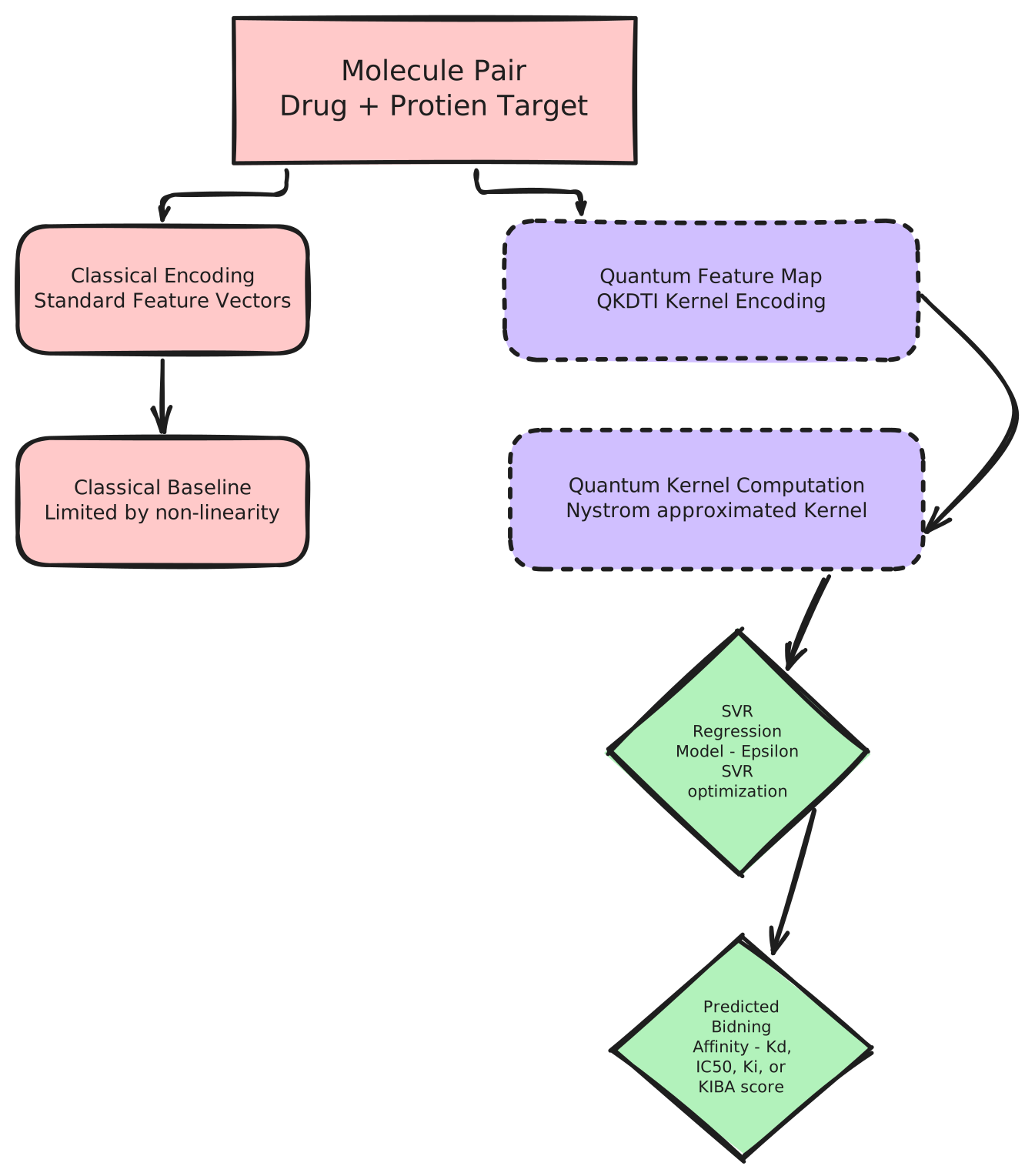 The classical approach hits a wall on non-linear binding patterns. QKDTI instead maps molecular pairs into a quantum feature space before computing the kernel that feeds the regression model.
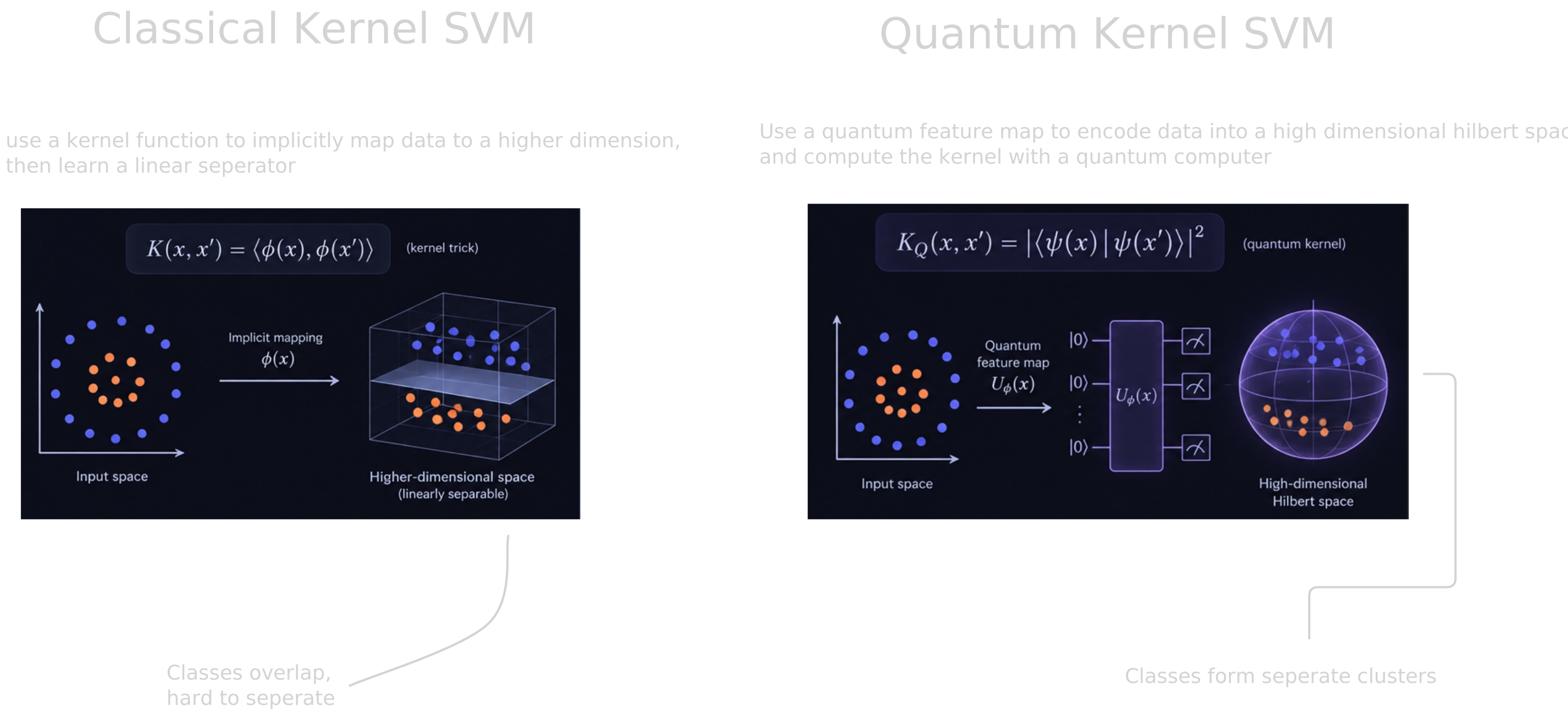 The intuition: the same data points that overlap and resist separation in a classical feature space can become cleanly separable once mapped into a quantum feature space.
My plan is to explore whether this same quantum kernel approach can be applied - or adapted - to Alzheimer's-relevant drug-target pairs specifically, rather than the general-purpose benchmarks the original paper used.
The math I'm working through
The core comparison, in plain terms:
- Classical kernel - a simple similarity measure between feature vectors. A dot product, or something like an RBF kernel based on distance.
- Quantum kernel - each input runs through a parameterized rotation circuit, and the kernel is the squared overlap between the two resulting quantum states.
Same inputs, structurally similar idea, very different computation underneath.
Concretely: the circuit below rotates each qubit based on the input values, entangles neighboring qubits so the mapping isn't just a set of independent rotations, then measures how much the two resulting states overlap. I haven't run this yet - it's me translating the math into something concrete enough to reason about:
import pennylane as qml
from pennylane import numpy as np

n_qubits = 4
dev = qml.device("default.qubit", wires=n_qubits)

def feature_map(x):
    """Encode x by rotating each qubit, then entangle neighbors."""
    for i in range(n_qubits):
        qml.RY(x[i], wires=i)
        qml.RZ(x[i], wires=i)
    for i in range(n_qubits - 1):
        qml.CNOT(wires=[i, i + 1])

@qml.qnode(dev)
def kernel_circuit(x1, x2):
    """Kernel = probability of measuring all-zeros after undoing x2's rotation."""
    feature_map(x1)
    qml.adjoint(feature_map)(x2)
    return qml.probs(wires=range(n_qubits))

def quantum_kernel(x1, x2):
    return kernel_circuit(x1, x2)[0]
Next step: actually running it against a couple of real DAVIS dataset entries and seeing if the numbers make any sense at all.
Where I actually am right now
The Bloch sphere is the first thing that made it click even a little: a classical bit is a light switch. A qubit is more like a compass needle that can point anywhere until you actually look at it.
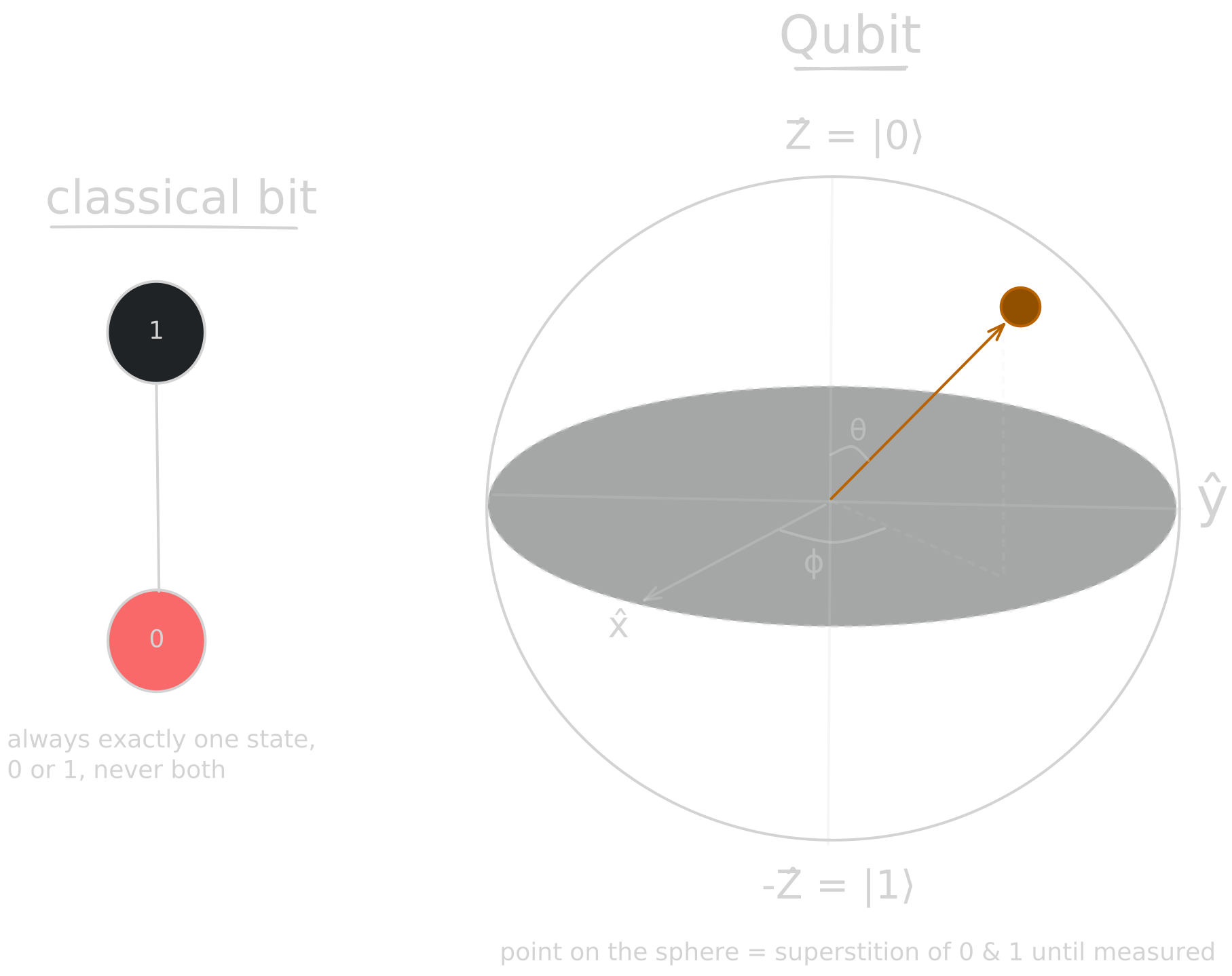 A classical bit is pinned to 0 or 1. A qubit is a point on the Bloch sphere - it can sit in a superposition of both, and only "collapses" to a definite value when measured.
From there, quantum kernels specifically are the part I'm least sure about. I get the general pitch - map data into a space where a simple method can find structure it couldn't find before - but I don't yet have real intuition for why the quantum version of that mapping is meaningfully better than a classical nonlinear kernel. I only know that QKDTI's results claim it is. Closing that gap is probably what I want most out of this project.
Which leads pretty directly into working through the QKDTI methodology in depth, instead of skimming the abstract - specifically how they landed on the RY/RZ rotation circuit, and why the Nystrom approximation (just 50 landmark samples standing in for the full kernel matrix) doesn't wreck the accuracy.
And running underneath all of that, I don't want to lose the actual biology. What does a binding affinity number mean in practice? Why does a small shift in it matter so much for Alzheimer's-specific targets? And maybe the real question: how would I even know if a "better" kernel is genuinely better for the problem I care about, versus just better at fitting benchmark noise on DAVIS and KIBA?